
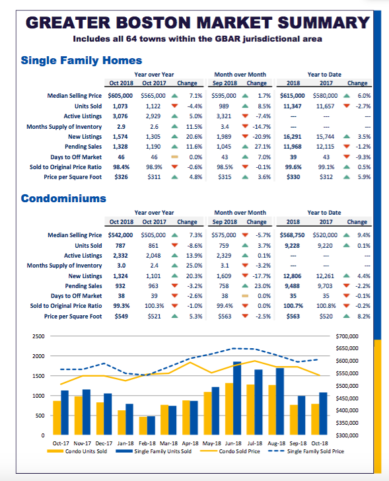
Here's October 2018s Monthly Indicators Report from the Greater Boston Association of Realtors showing Boston real estate market trends.

Here's October 2018s Monthly Indicators Report from the Greater Boston Association of Realtors showing Boston real estate market trends.
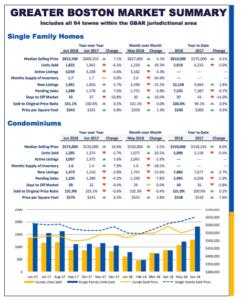
Here's June 2018s Monthly Indicators Report from the Greater Boston Association of Realtors showing Boston real estate market trends.

Covering parts of Back Bay, Downtown Crossing and Bostons prestigious Beacon Hill neighborhood. 02108 is bursting with historic and upscale homes. Beacon Hill posted a $1,432,500 median sale price in 2017, a slight uptick from 2016 figures.
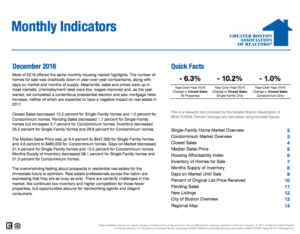
Most of 2016 offered the same monthly housing market highlights. The number of homes for sale was drastically down in year-over-year comparisons, along with days on market and months of supply.
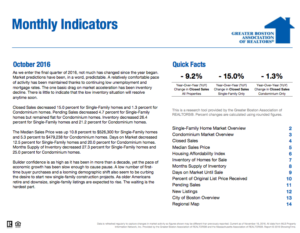
As we enter the final quarter of 2016, not much has changed since the year began. Market predictions have been, in a word, predictable. A relatively comfortable pace of activity has been maintained thanks to continuing low unemployment and mortgage rates.
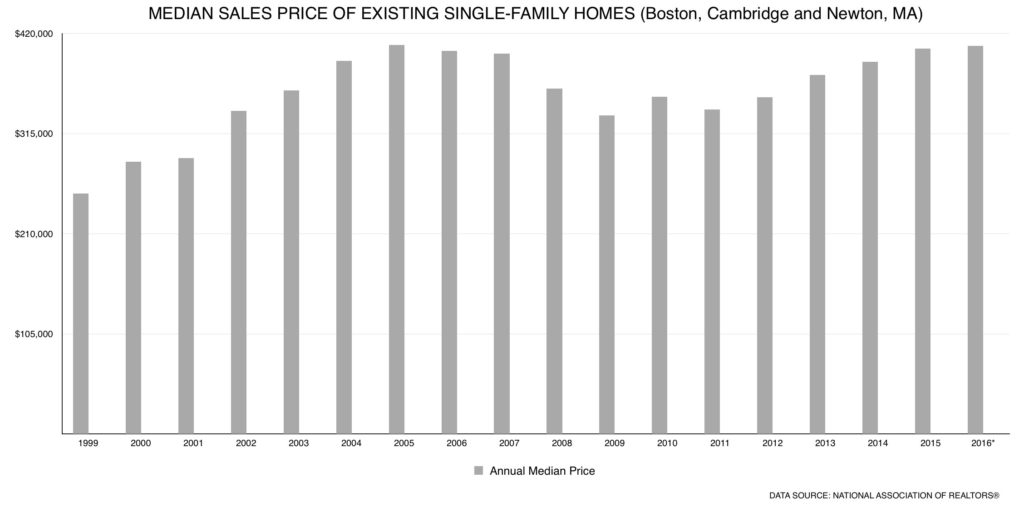
There are some industry pundits claiming that Boston area residential home values have risen too quickly and that current levels are on the verge of another housing bubble
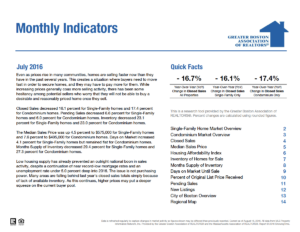
Even as prices rise in many communities, homes are selling faster now than they have in the past several years. This creates a situation where buyers need to move fast in order to secure homes, and they may have to pay more for them.
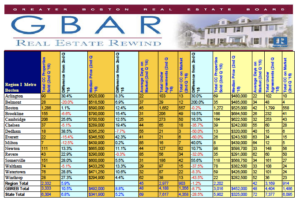
Here's the latest update of Real Estate Rewind Q2 2016, an online quarterly report produced by the Greater Boston Real Estate Board (GBAR) which summarizes residential real estate market activity in the GBAR jurisdictional area.
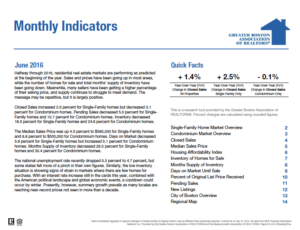
Halfway through 2016, residential real estate markets are performing as predicted at the beginning of the year. Sales and prices have been going up in most areas, while the number of homes for sale and total months' supply of inventory have been going down.

So if housing inventory is measured in months of supply where less than 6 months is considered a seller's market and greater than 7 months is considered buyer's market, what are the differences between and features of the two different markets?

 Only real estate professionals who are members of NATIONAL ASSOCIATION OF REALTORS® may call themselves REALTORS®. All REALTORS® must subscribe to NAR’s strict code of ethics, which is based on honesty, professionalism and the protection of the public.